![]() |
| These are the first wild yellow lady's slippers I've ever seen. They are not just a yellow version of pink lady's slippers; they are a different species. |
![]() |
| These are the first wild yellow lady's slippers I've ever seen. They are not just a yellow version of pink lady's slippers; they are a different species. |
![]() |
| Mid-May is prime season for pink lady's slipper orchids in the New Jersey Pine Barrens. I went hunting for them last week. |
| They were blooming right on schedule. |
| For a flower so brightly colored, they are surprisingly difficult to see and must be stalked. Click to enlarge. |
| Here's a nice one, showing off its twisting sepals and puffy pouch. |
| I also saw this adorable eastern chipmunk. |
| The New Jersey Pine Barrens -- dark pools, interesting plants, cute mammals, and a legendary resident Devil. What's not to like? |
| My search for wild pink lady's slipper orchids in the New Jersey Pine Barrens has paid off. |
| Behold! Click to enlarge. |
| Pink lady's slippers are also called moccasin flowers, American valerian, and squirrel shoes. |
![]() |
| According to the U.S. Forest Service, a pink lady's slipper orchid plant can live for 20 years or more. They are unlikely to survive transplanting. |
| Pink lady's slipper are blooming now through mid-June in the New Jersey Pine Barrens. Get out there and find them. |
| I spent another day in the New Jersey Pine Barrens, looking for wild pink lady's slipper orchids. According to the New Jersey Pinelands Commission's orchid blooming schedule, the flowers can be found from early May to mid-June. I was on the job on May 1. |
| I love when clouds reflect in the ponds like this. |
| There were lots of pretty things to see, like these red maple seeds. Click to enlarge. |
| I can report that purple pitcher plants are growing new insect-trapping pitchers. |
| Behold! I found several. But... they all were all newly sprouted like the one above, all with their slippers wrapped in green. Not pink lady's slippers -- green ones! |
| So, I did not quite find what I was looking for. I think one more trip to the pines will do it. |
| They grow in association with a fungus that enables germination and provides nutrients to the plant. After the plant is established it provides nutrients to the fungus, in turn. |
| To celebrate their return, a poem by Wendell Berry, from Given Poems, Sabbaths II: | |
"I dream of a quiet man
who explains nothing and defends
nothing, but only knows
where the rarest wildflowers
are blooming, and who goes,
and finds that he is smiling
not of his own will."
![]() |
| Mid-May is time to go hunting for lady's slipper orchids in the New Jersey pine barrens (with a face mask). Did it. Found them. Here they are. Click to enlarge. |
![]() |
| Joseph Pullman Porter wrote a poem called Wild Orchids that begins: Under the pines, near the murmuring brook, I know the wild orchids grow, Fair and pure in their shady nook... Exactly describing the spot where I found this orchid. Brook, shady nook, and all. |
![]() |
| Beautiful but a little bit creepy, right? These are the first sightings of my 2020 orchid season. I will be on the lookout for more and post them when I find them. |
![]() |
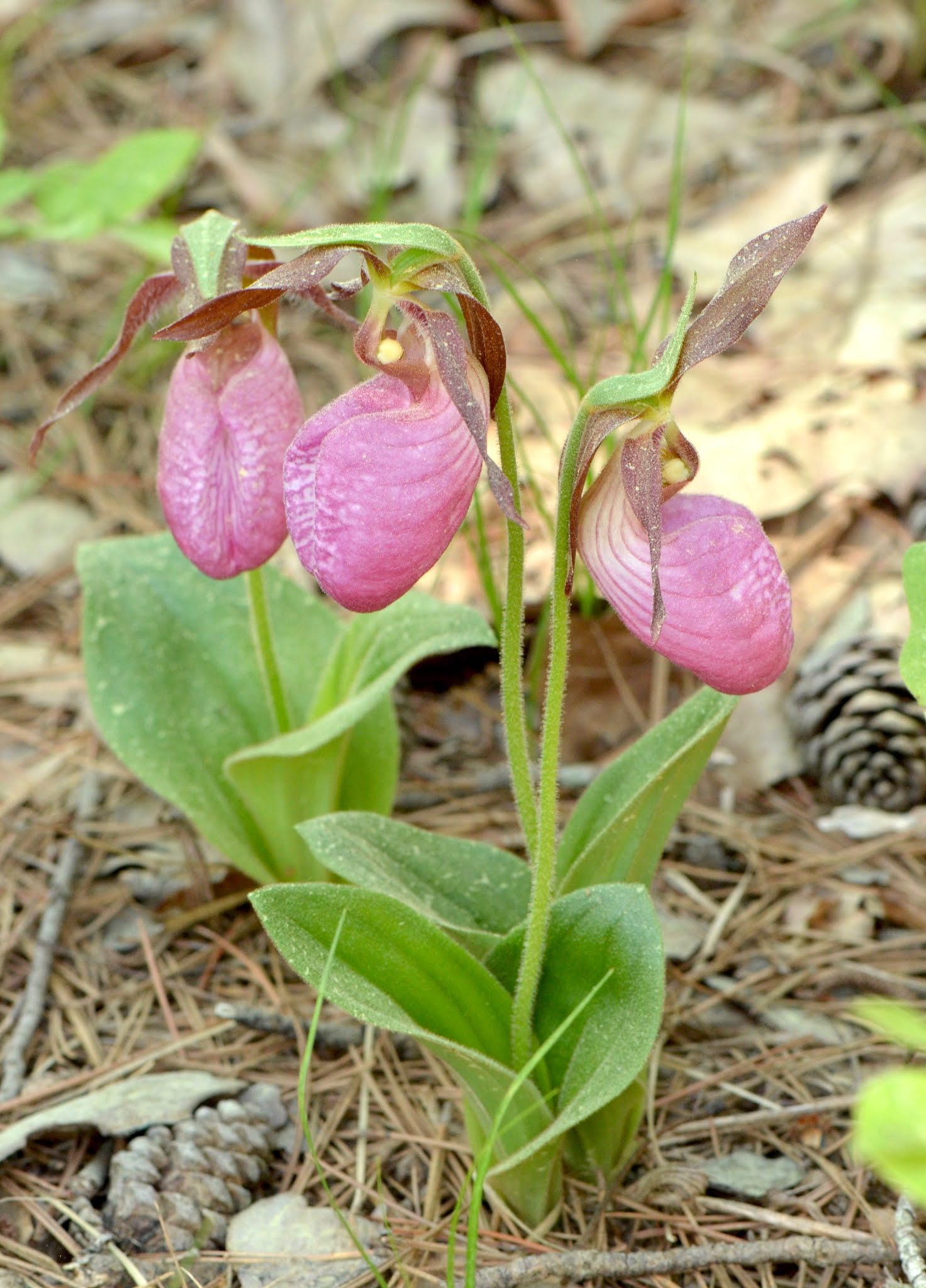
| Pink lady's slipper orchids, Cypripedium acaule, bloom in the New Jersey Pine Barrens from early May to mid-June. That's now! Here are a few I saw on May 18th. Click to enlarge. |
![]() |
| They are also called moccasin flowers. |
![]() |
| They grow in association with a fungus that enables germination and provides nutrients to the plant. Once the plant is established it returns the favor by providing nutrients to the fungus. |
![]() |
| Individual plants can live for 20 years and longer in the wild. Once you find some, you can visit the same spot every spring to see them. |
![]() |
| The lady's slipper flower smells good to bees and the big pouch has a slit in the front that allows a bee to enter. Once inside, hairs direct the bee to an upper exit that requires squeezing past a pollen mass. Tricky! |