Showing posts with label periodical cicada. Show all posts

Sunday, June 2, 2024

Brood XIX Hits St. Louis


I have the good luck to be in St. Louis, Missouri, while a big emergence of periodical cicadas is happening. There are billions of buzzing cicadas out there. People are calling it "Cicadageddon." This brood emerges every 13 years, so they were last seen in 2011. They'll be back in 2037. Click here to read my eyewitness account of the emergence of a periodical cicada brood. Click on the photo to enlarge. Gotta love that face, right?

Sunday, June 13, 2021

Meet Brood X


The 17-year periodical cicadas we were expecting are here. I saw lots of them this week in Central New Jersey at Sourland Mountain, Skillman, and all over Princeton. If you'd like to see them, head to any park in those areas. Or maybe visit Grovers Mill in West Windsor Township. (The town in which the imaginary alien invasion was set in the War of the Worlds.) Click to enlarge.

After spending 17 years underground in dark quiet, the cicadas have these few weeks in the sun to sing, and fly, and mate. I am thrilled to witness the spectacle.

You hear them before you see them. At first they sound like the familiar cicadas of August, but as you get close, they get loud, really loud, because there are so many of them. At full volume the high whirring song makes me think of spaceships landing.

For South Jersey people who would like to search for Brood X locally, they were reported during the last emergence in 2004 in Stockton, Marlton, and Browns Mills. 

Here's to Brood X. See you in 2038.

Sunday, August 16, 2015

Dog Day Cicadas

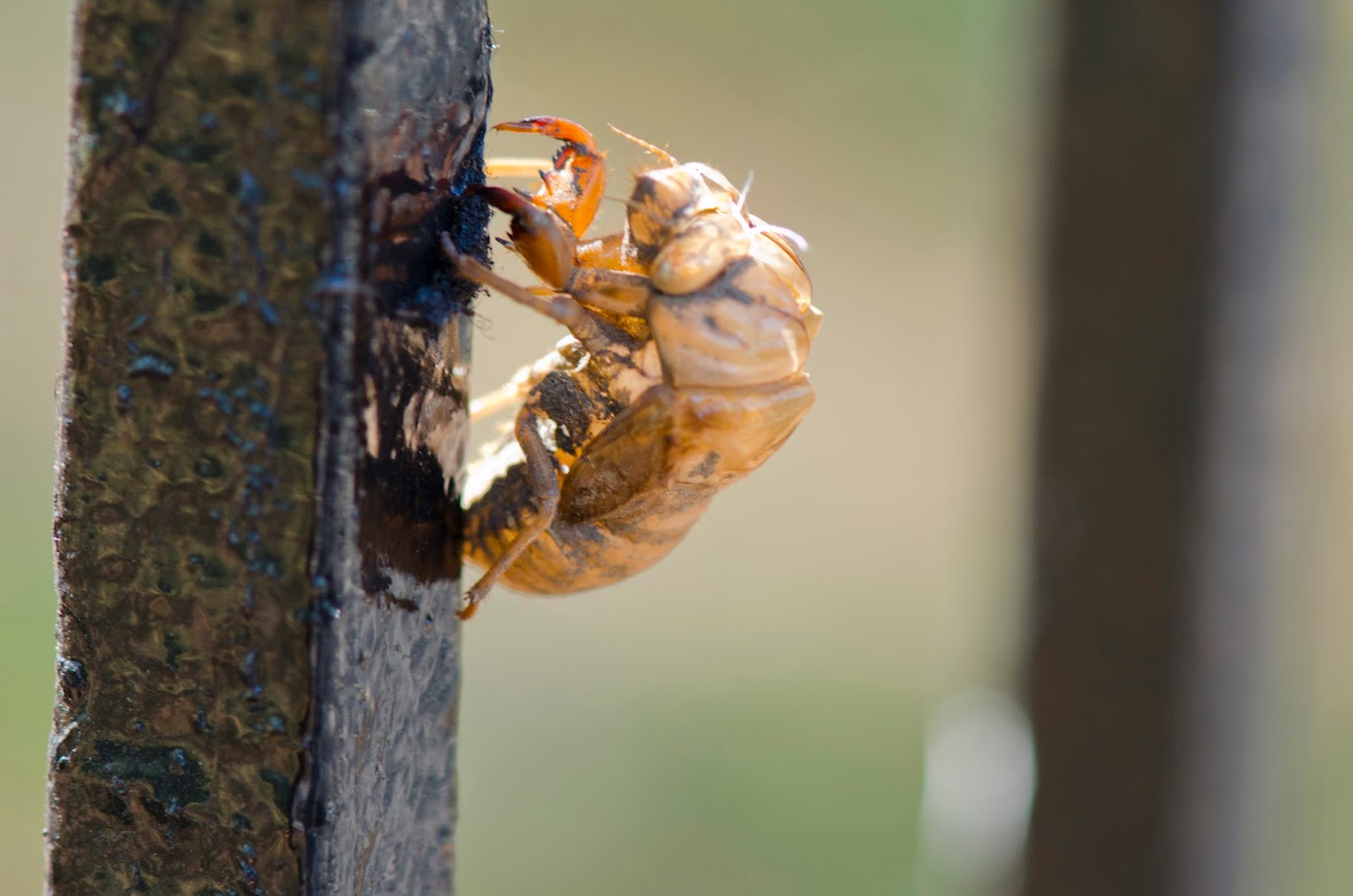
This empty cicada skin caught my eye. Click on the photos to enlarge. 
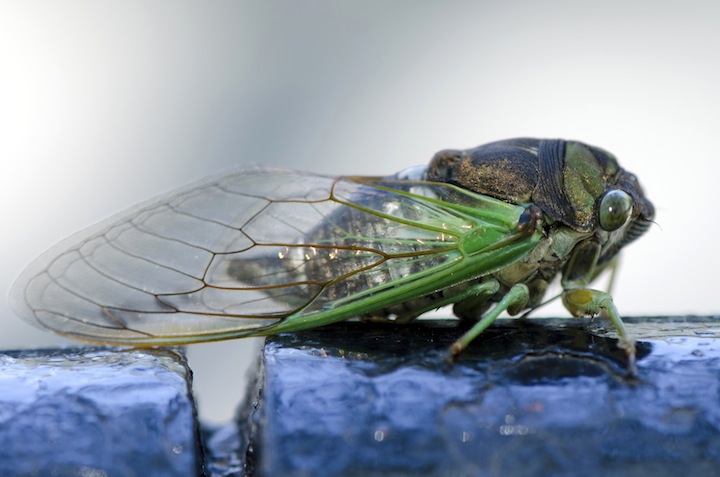
A few feet away on the same fence, I found this fresh looking  cicada.  It probably shed that skin a short time ago. It is one of the group of cicadas called dog day or annual cicadas that appear from June to late summer. This one is Neotibicen tibicen, called the morning cicada because the males sing early in the day. 
It is about 2 inches long. Notice the three ocelli or eyespots on its forehead, between the 2 large compound eyes. The famous periodical cicadas, the ones that emerge in 13 or 17 year cycles,  are smaller and have red eyes and emerge earlier in the year.
Here is a periodical cicada from the 2013 emergence, for comparison. Click here to read my eye-witness account of that event. 
Some annual cicadas appear  every year. But the life cycles of individuals take from 2 to 5 years, beginning as eggs laid in slits on tree branches. A nymph hatches, falls to the ground, and burrows down. It lives underground, sucking juices from plant roots, and grows. Eventually it reaches its last nymphal stage and claws its way upward to make an exit tunnel. It climbs onto something and sheds its skin, and emerges as an adult.

The males settle down and sings to attract females to mate. Different species of cicadas sing different songs and at different times of day or night. They sing with an organ called a timbal which is made of ribbed membranes that change shape with a click when pulled on by muscles. The clicks are magnified by various hollow chambers in the insect.

The dog days of summer were named by the ancients for the appearance of the dog star in the sky near dawn in July and August. We are in the dog days now; it's hot and humid, and the nights are loud with the songs of dog day cicadas.

Sunday, June 16, 2013

Cicadas !

A periodical cicada out of the ground after 17 years and enjoying his salad days. Click to enlarge. 
I walked through a large swarm of cicadas today in the Mid-Hudson Valley of New York. Everywhere I looked, cicadas were flying from perch to perch in the trees. Plants were covered with them, or with their empty skins. Their whirring chirping songs were as loud as New York City traffic on Broadway at rush hour.

A shed cicada skin attached to a leaf. 
The cicadas emerging around New York now are members of a huge group called Brood II that has a geographic range that includes North Carolina, Virginia, New Jersey, New York, and Connecticut. The cicadas are synchronized to emerge in the same year when the local soil temperature is just right.

They crawl out of the ground in an incompletely developed form called a nymph, then attach to a surface and shed their outer skin (exoskeleton) and emerge as adults.  Males fly off to sing in the trees. Females are attracted to the songs. Couples mate. Females lay eggs on twigs. The adults die after about three weeks. In six to ten weeks, the eggs hatch into tiny nymphs and fall to the ground. They burrow down. And there they stay, sucking on roots, until before you know it, 17 years have passed, it is time for the brood to emerge.

The ground was full of holes recently vacated by cicadas. 


I saw them near the Stony Kill Farm Environmental Educational Center in Wappinger Falls. If you want to look for them, drive north on route 90 past the farm with your windows open. When you hear a loud whirring that suggests a giant spaceship overhead, you have found swarmaggedon. Or was that cicadapocalypse?

There were piles of shed skins and dead adults on the ground. 

We'll be back in 2030! :-)