Sunday, August 16, 2015

Dog Day Cicadas

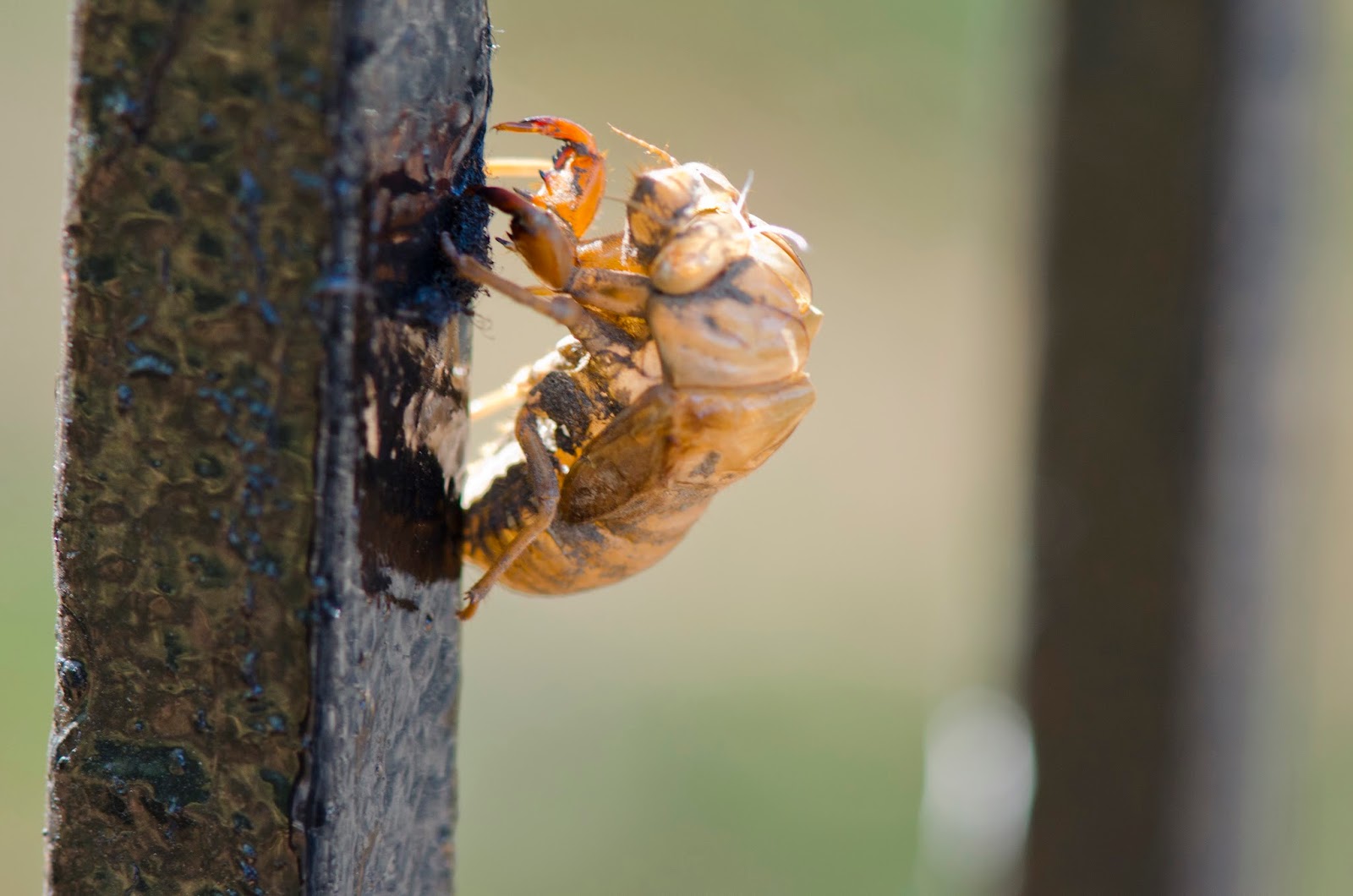
This empty cicada skin caught my eye. Click on the photos to enlarge. 
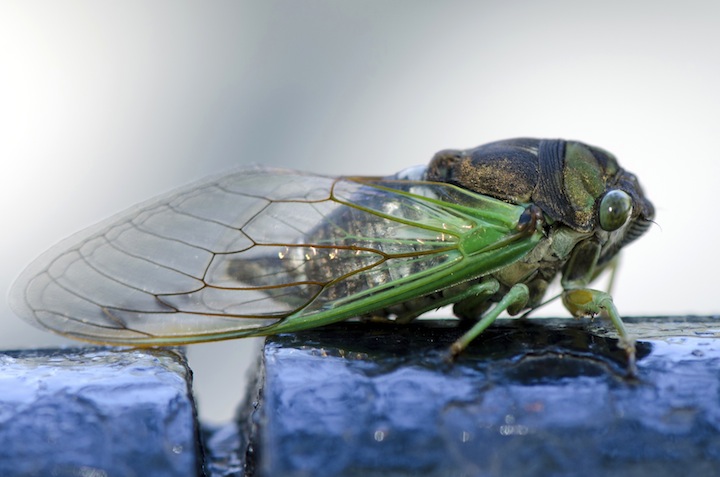
A few feet away on the same fence, I found this fresh looking  cicada.  It probably shed that skin a short time ago. It is one of the group of cicadas called dog day or annual cicadas that appear from June to late summer. This one is Neotibicen tibicen, called the morning cicada because the males sing early in the day. 
It is about 2 inches long. Notice the three ocelli or eyespots on its forehead, between the 2 large compound eyes. The famous periodical cicadas, the ones that emerge in 13 or 17 year cycles,  are smaller and have red eyes and emerge earlier in the year.
Here is a periodical cicada from the 2013 emergence, for comparison. Click here to read my eye-witness account of that event. 
Some annual cicadas appear  every year. But the life cycles of individuals take from 2 to 5 years, beginning as eggs laid in slits on tree branches. A nymph hatches, falls to the ground, and burrows down. It lives underground, sucking juices from plant roots, and grows. Eventually it reaches its last nymphal stage and claws its way upward to make an exit tunnel. It climbs onto something and sheds its skin, and emerges as an adult.

The males settle down and sings to attract females to mate. Different species of cicadas sing different songs and at different times of day or night. They sing with an organ called a timbal which is made of ribbed membranes that change shape with a click when pulled on by muscles. The clicks are magnified by various hollow chambers in the insect.

The dog days of summer were named by the ancients for the appearance of the dog star in the sky near dawn in July and August. We are in the dog days now; it's hot and humid, and the nights are loud with the songs of dog day cicadas.

Sunday, August 9, 2015

A walk in New Jersey

I took a nice long walk in New Jersey today. I was about an hour's drive from New York City in Hopewell. It looked like this... 
I saw this huge caterpillar, fat, and about 4 inches long. It's a Pandorus Sphinx moth caterpillar, Eumorpha pandorus.  It's one of the caterpillars commonly called a hornworm, because in its younger stages it sports a horn on its rear end (which is on the left in this photo).  Click to enlarge. 
The spot where the horn grows becomes a button on later-stage caterpillars like this one. It's that eye-like black spot-in-a-circle.  One of its foods is Virginia creeper; there was lots of it around. 
And lots of Queen Anne's lace. 
And lots of butterflies. The one on the left in this picture, is a female clouded sulphur. On the right, in flight and blurry, is an orange sulphur male. These two species sometimes hybridize so they may have been up to something. 
And this young fellow peeked out from the trees. 

Sunday, August 2, 2015

A Four-toothed Mason Wasp

The solitary wasp, Monobia quadridens, commonly called the four-toothed mason wasp, it's black and white and about an inch long. Click to enlarge. 
This lovely wasp can be found drinking nectar at flowers throughout the eastern United States right now. It is a good wasp to have around the garden because the females round up leaf-rolling caterpillars -- the kinds that eat your plants -- to provision their nests. When it is time to reproduce, the female wasp builds a small nest, often in a wood bore made previously be a carpenter bee. She paralyzes caterpillars with a sting and flies them to the nest, stuffs one or a few into the deep end of the hole, and lays an egg there. Then she seals up that cell with mud and repeats the process, but famously leaves empty cells between occupied ones, possibly to fool invaders into thinking the nest is empty. The eggs hatch into wasp larvae that feed on the caterpillars.

August is a great month to look for interesting wasps and bees. All you need is a sunny day, flowers, patience, and luck. If you take a camera you might capture a great moment.


Sunday, July 26, 2015

A Bubbling Bee

A while ago I wrote a blog about the fly pictured above. I'd caught it in the unlikely act of blowing a bubble. Click on it to enlarge. (Click here to read that blog.) Although no one knows why flies blow bubbles, theories range from concentrating liquid food by evaporation, to aerating to reduce some kinds of microbial activity, to fly sickness, cleaning the mouthparts, cooling off by evaporation, and more. I thought I had been pretty lucky to take that photograph at just the right moment. Once in a lifetime, right? 
So imagine my surprise when I enlarged this photo, which I had taken casually and only because I didn't recognize the insect. It turned out to be an invasive species of bee called a punctate masked bee, Hylaeus punctatus. The species has only recently been introduced to the United States. AND IT IS BLOWING A BUBBLE! I normally wouldn't use a picture this blurry in a blog, but a bee blowing a bubble trumps that for blog worthiness. And now, like a strict elementary school teacher with a classroom full of unruly gum-chewing kids, I'll be checking every insect I see for secret bubbles. 

Sunday, July 19, 2015

Red Milkweed Beetle

The red milkweed beetle, Tetraopes tetrophthalmus. 
The red milkweed beetle is another nice summer insect. It's a longhorned beetle, in the family Cerambycidae. Check out its extreme antennae.

The red milkweed beetle's genus and species names are derived from Latin and mean four-eyed. Many species in the longhorned beetle family have antennae that originate close to the eyes, some so close that the eyes look indented. In the red milkweed beetle each compound eye is completely separated into two by the placement of the antennae and violà -- four eyes!

Click to enlarge and check out the antenna with an eye on each side. 
Red milkweed beetles are among the few things that can eat the toxin-containing plants of the milkweed genus, Asclepias. They are able to store the toxins and end up unpalatable to potential predators, which they advertise with their showy colors.
Red milkweed beetles are not the only red and black insects you can find on milkweeds. I've written about two others: large and small milkweed bugs. The red X on its back identifies this small milkweed bug, Lygaeus kalmii. 


The ones with a broad black band across the back are called large milkweed bugs, Oncopeltus fasciatus. You can read a blog I wrote previously about these bugs by clicking here.  And another blog about both kinds by clicking here. 


Combined with monarch butterflies, that are also milkweed specialists in the caterpillar stage, red milkweed beetles and large and small milkweed bugs make for exciting times in the milkweed patch for insect enthusiasts.

Sunday, July 12, 2015

Summer Azure

The summer azure butterfly, Celestrina neglecta. Click to enlarge. Note the handsome black and white striped antennae. 
Summer azure butterflies are all over Brooklyn's flowers right now. The place is teeming with them. But they are small and often overlooked. Their wingspan is about an inch, so the one pictured above is just half an inch tall. They are white underneath and usually hold their wings closed over their backs. It is easy to mistake them for flower petals when they perch on blossoms. The upper surface of the wings is powdery blue.

Summer azures are in the butterfly family Lycaenidae, famously studied by Vladimir Nabokov and commonly called "blues." Although I stood for an hour with my shutter poised, these little ones were too busy to linger with their wings open so I did not get a single shot of the blue surface.

Like many other members of their butterfly family, summer azures spend their catterpillarhood in the company of helpful ants. The ants protect them by driving off hostile insects. The caterpillars in return produce a sweet substance from a nectary organ (on their backs) that the ants eat. It's rather like humans keeping cows for milk, except it's ants and caterpillars.

Adult summer azures eat flower nectar. In this photo you can see the butterfly's long proboscis probing the flower blossom. 


Here is a poem I like that has a blue butterfly in it. 

Butterfly Laughter, by Katherine Mansfield

In the middle of our porridge plates
There was a blue butterfly painted
And each morning we tried who should reach the 
butterfly first.
Then the Grandmother said: "Do not eat the poor 
butterfly."
That made us laugh.
Always she said it and always it started us laughing.
It seemed such a sweet little joke. 
I was certain that one fine morning 
The butterfly would fly out of our plates, 
Laughing the teeniest laugh in the world, 
And perch on the Grandmother's lap.


Sunday, July 5, 2015