Sunday, July 28, 2013

100,000 Pageviews!


A threesome of three-lined potato beetles, Lema daturaphila. Click. 

The Urban Wildlife Guide just hit 100,000 pageviews. I'm taking the day off to bask in the glow...

Sunday, July 21, 2013

Atlantic Ghost Crab

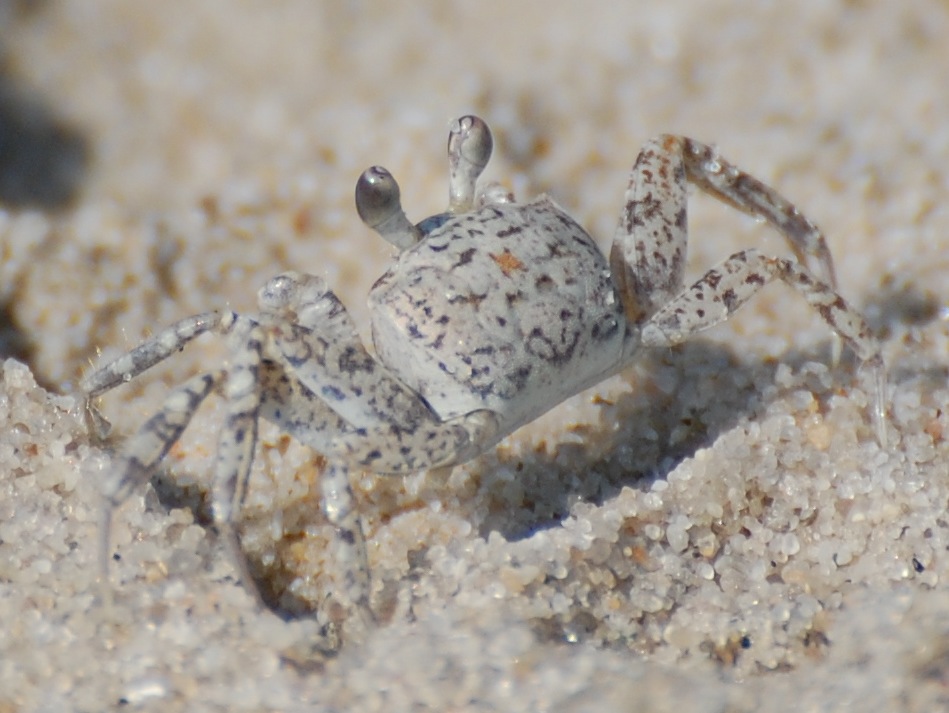
Atlantic ghost crab, Ocypoda quadrata. Click to enlarge. 
I met this little crab on a beach in Cape May, New Jersey. It's Ocypoda quadrata, called a ghost crab or sand crab.

The Latin name Ocypoda means "fast-footed," and quadrata describes the rectangular shape of its carapace, or back. It is pale like a ghost, and camouflaged to blend with the sand. It is famous for hunkering down and covering itself with sand very quickly, seeming to disappear before your eyes.

Ghost crabs live in burrows in the sand above the high water line. They don't go far from the ocean; females lay their eggs in the water.   The crabs are mainly nocturnal, but they come out in the day. They hunt at the water's edge, running after the retreating surf to pick up bits of food like sand fleas, clams, mole crabs, turtle eggs, detritus, and vegetation. Ghost crabs are common on Atlantic coastal beaches from Rhode Island south to Brazil.

Ghost crabs have eyes on long stalks that let them see 360 degrees around; there's no sneaking up on a ghost crab!

Sunday, July 14, 2013

Growing Caterpillar

A black swallowtail butterfly caterpillar. Click to enlarge. 
For the past few weeks, I have been watching black swallowtail caterpillars in a nearby stand of fennel plants. Like many butterfly species, black swallowtails are picky about what they eat. They prefer host plants in the carrot family, Apiaceae, which includes parsley, fennel, dill, Queen Anne's Lace, and of course, carrots.

Fennel smells like licorice candy. It is delightful to look for caterpillars on fennel plants, because as I brush the lacy fronds, they release a sweet licorice smell. I usually wonder in passing what it's like to live on an exclusive diet of fennel.

Adult females lay eggs on the plants. A tiny caterpillar hatches right on its food and starts to eat. It eats and eats until it grows to the maximum size its external skeleton will allow. Then it sits quietly while its skin splits; it emerges larger and ready for the next growth stage. Each stage is called an instar. Black swallowtails have five instars.

Today, as I was taking a walk, I found the caterpillar pictured above. It was sitting very still. I learned later that it was about to change its skin. After walking in the neighborhood for a few hours, I stopped at the fennel plant to look again.  The picture below shows what I saw -- a new instar, feasting on its old skin. The caterpillar was efficiently recycling its resources. I could not help thinking that it probably tasted like licorice.

A newly emerged black swallowtail caterpillar, eating its old skin. 

Sunday, July 7, 2013

A Baby Wheel Bug !

I found a tiny assassin sitting on a yellow flower in Brooklyn Bridge Park last week. It's an immature, or nymphal, stage of an assassin bug.

Assassin bugs are predatory insects in the family Reduviidae. They have long downward-facing beaks that unfold forward. Assassin bugs capture other insects and pierce them with their sharp beaks. Then they inject enzymes to paralyze and dissolve. Then they suck out the victim's liquified insides.

Click to enlarge. You can see the bug's developing little beak. 
The orange and black nymph pictured above overwintered in an egg that its mother laid on a plant last fall. It hatched this spring and will pass through five nymphal stages until it is a fully grown adult some time this summer.

And it's not just any assassin bug, it is Arilus cristatus -- a wheel bug!

When it is fully grown, it will look like this adult wheel bug. Get a load of the beak on this! 
The wheel bug is one of the largest terrestrial bugs in North America. Adults are about an inch and a quarter long. It is named for the cog-shaped armor on the adult's back.

If you get a chance, check the foliage around the Pier 1 entrance to the Squibb Park Pedestrian Bridge this summer. At least one great big wheel bug will be hunting there.

Sunday, June 30, 2013

New Ducks in the Park

An adult female mallard duck, Anas platyrhynchus, with three immatures. Mother duck is at the top of the photo. Click to enlarge.
I was walking in Brooklyn Bridge Park last week, descending the north-most path in the water gardens. I heard plop plop. Two ducks had slipped from the little bridge into the water. They were two of three almost fully-grown immature mallard ducks with an adult female. They all looked at me for a moment, then the mother turned and led the way into the reeds. They paddled into the thick high foliage at the southern end of the little pond by the wine bar and disappeared. I barely had time to take these photos.

I went to the other end of that patch of plants, thinking the ducks might come out, but no. They had quietly slipped into a spot where they could not be seen. There in the middle of metropolis, with hundreds of walkers, joggers, and bikers passing every day, the ducks have a secret spot. I wonder if they've been there since February and March when I saw ducks mating on the pond? 

Mallard duck eggs take about a month to hatch. The chicks stay with their mother for about eight weeks until they are able to fly, or fledge. So, yes, one of the ducks I saw mating at the end of winter may have built a nest deep in the reeds, laid eggs, hatched chicks, and discretely mothered her flock in the area all that time, eluding me on my frequent prying walks in the park. 

Well played, mother duck!


Sunday, June 23, 2013

Eastern Towhee

A male eastern towhee, Pipilo erythrophthalmus, has reddish eyes and a long black tail. Head, back, and breast are black;  wings black with white streaks; belly white; sides rusty red. Click to enlarge. 
I always hear towhees before I see them. In spring, males sit conspicuously in treetops singing what birdwatchers think sounds like: "Drink your teeeeeeee!" The first note is sharp and the last is a musical trill. Click here to watch and listen to a towhee singing the famous towhee song. 

Or I hear them scratching in the underbrush. Getting a look at a foraging towhee is more challenging. They dig in leaf litter  to uncover food items, typically scratching with both feet while hopping backwards. They make a lot of noise, so I sometimes investigate the sound expecting rabbits or raccoons or some other large noisy thing. Towhees sometimes turn up insects that way, or millipedes or snails, all of which they will happily eat. They also eat seeds and fruit.

Eastern towhees are found in the eastern half of north america. In the northeast, we only see them in spring and summer when they come to nest. This pair were foraging in the open grass around Pakim Pond in the New Jersey pine barrens. I've seen them in Central Park in Manhattan, and many places in between.

A female eastern towhee is also about 7 inches long, with the same color pattern, but has brown feathers where the male has black. 


Sunday, June 16, 2013

Cicadas !

A periodical cicada out of the ground after 17 years and enjoying his salad days. Click to enlarge. 
I walked through a large swarm of cicadas today in the Mid-Hudson Valley of New York. Everywhere I looked, cicadas were flying from perch to perch in the trees. Plants were covered with them, or with their empty skins. Their whirring chirping songs were as loud as New York City traffic on Broadway at rush hour.

A shed cicada skin attached to a leaf. 
The cicadas emerging around New York now are members of a huge group called Brood II that has a geographic range that includes North Carolina, Virginia, New Jersey, New York, and Connecticut. The cicadas are synchronized to emerge in the same year when the local soil temperature is just right.

They crawl out of the ground in an incompletely developed form called a nymph, then attach to a surface and shed their outer skin (exoskeleton) and emerge as adults.  Males fly off to sing in the trees. Females are attracted to the songs. Couples mate. Females lay eggs on twigs. The adults die after about three weeks. In six to ten weeks, the eggs hatch into tiny nymphs and fall to the ground. They burrow down. And there they stay, sucking on roots, until before you know it, 17 years have passed, it is time for the brood to emerge.

The ground was full of holes recently vacated by cicadas. 


I saw them near the Stony Kill Farm Environmental Educational Center in Wappinger Falls. If you want to look for them, drive north on route 90 past the farm with your windows open. When you hear a loud whirring that suggests a giant spaceship overhead, you have found swarmaggedon. Or was that cicadapocalypse?

There were piles of shed skins and dead adults on the ground. 

We'll be back in 2030! :-)